顔料イエロー97:特性、用途、および技術ガイド
Pigment Yellow 97 is an important organic yellow pigment used in a wide range of industrial coloring applications, including plastics, coatings, printing inks, and other polymer-based products. Its combination of yellow color strength, processing performance, and application versatility makes it a useful choice for manufacturers looking for a reliable organic yellow pigment.
For plastic processors, coating manufacturers, ink producers, compounders, and industrial pigment buyers, understanding the properties and application characteristics of Pigment Yellow 97 is important when selecting a suitable pigment for a specific formulation. This guide explains what Pigment Yellow 97 is, its key properties, common applications, processing considerations, and how to select a reliable ピグメントイエロー 97 manufacturer or supplier.
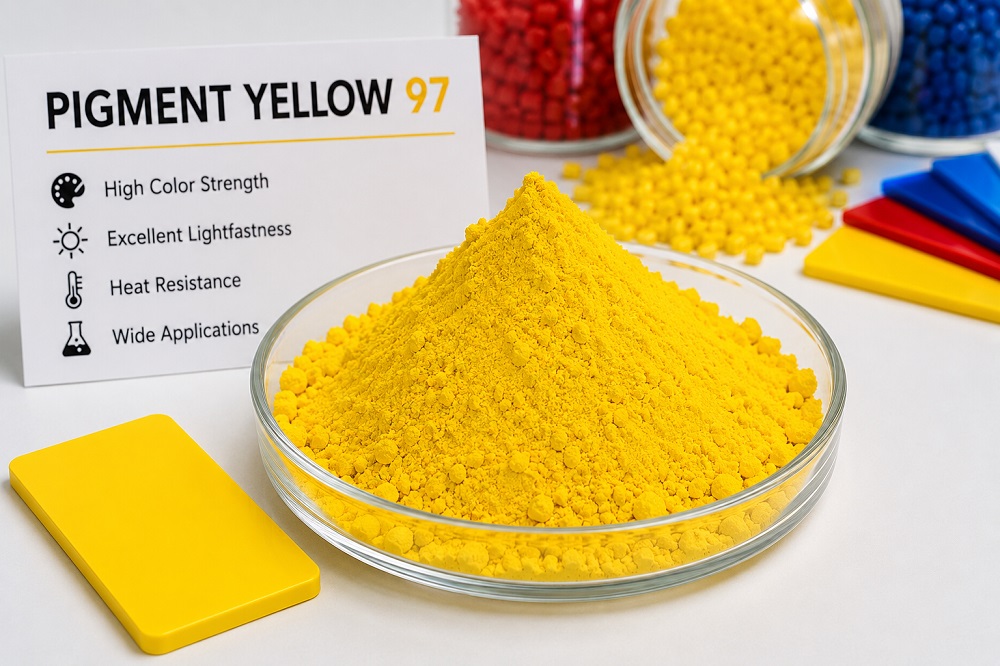
What Is Pigment Yellow 97?
Pigment Yellow 97 is a synthetic organic yellow pigment belonging to the azo pigment family. It is used to provide yellow coloration in different industrial materials and formulated products.
Like other organic pigments, the performance of Pigment Yellow 97 depends not only on its chemical structure but also on factors such as particle characteristics, pigment purity, surface treatment, dispersion behavior, and manufacturing technology. Different commercial grades can therefore be developed for different applications and performance requirements.
Key Characteristics of Pigment Yellow 97
Pigment Yellow 97 is valued for its strong yellow color and versatility in industrial applications. Depending on the specific grade, it can offer a useful balance of coloring strength, dispersion, heat resistance, and durability.
- Bright and attractive yellow coloration
- Good coloring strength
- Suitable for a variety of industrial applications
- Good dispersion potential
- Applicable to plastics, coatings, and printing inks
- Available in different commercial grades
- Suitable for bulk industrial pigment supply
Pigment Yellow 97 Properties
The technical properties of Pigment Yellow 97 can vary according to the manufacturing process and commercial grade. When selecting a pigment, customers should evaluate the technical data sheet and application-specific test results provided by the pigment manufacturer.
Color Strength and Yellow Shade
Color strength is one of the most important factors when selecting an industrial pigment. Pigment Yellow 97 can provide strong yellow coloration and can be incorporated into different formulations to achieve the required shade.
The final color appearance can be influenced by pigment concentration, particle size, dispersion quality, resin or polymer type, processing conditions, and the presence of other pigments or additives.
Dispersion Performance
Good pigment dispersion is essential for achieving uniform color and consistent finished-product quality. Pigment Yellow 97 can be formulated for applications where efficient dispersion is required.
Proper dispersion can help reduce color variation, improve surface appearance, and maximize the effective coloring strength of the pigment. The appropriate dispersion method depends on the application, equipment, carrier system, and formulation.
耐熱性
Heat resistance is an important consideration when Pigment Yellow 97 is used in plastics. During extrusion, injection molding, and other polymer processing operations, pigments may be exposed to elevated temperatures.
Manufacturers should therefore select a Pigment Yellow 97 grade that is suitable for the processing temperature and residence time of the intended polymer system. Actual heat resistance should be confirmed using the supplier's technical specifications and application testing.
耐光性
Lightfastness describes the ability of a pigment to maintain its color when exposed to light. This property can be particularly important for coatings, outdoor plastic products, and other applications exposed to sunlight or artificial light.
Different Pigment Yellow 97 grades may provide different levels of lightfastness. For applications requiring long-term outdoor durability, buyers should discuss exposure conditions and performance requirements with the pigment supplier.
Chemical Resistance
Chemical resistance can affect pigment performance in coatings, plastics, inks, and other formulated products. The interaction between a pigment and the surrounding resin, solvent, plasticizer, additive, or chemical environment should be considered during product selection.
Application testing is recommended when Pigment Yellow 97 will be used in demanding chemical environments.
Pigment Yellow 97 Applications
Pigment Yellow 97 can be used in several industrial sectors. The most common application areas include plastics, coatings, printing inks, masterbatch, and other products that require yellow coloration.
Pigment Yellow 97 for Plastics
Plastics are an important application area for organic yellow pigments. Pigment Yellow 97 can be used to color a variety of thermoplastic materials and polymer-based products.
Potential applications include plastic packaging, household products, consumer goods, molded plastic components, plastic profiles, containers, and other colored polymer products.
When using Pigment Yellow 97 in plastics, manufacturers should consider the polymer type, processing temperature, pigment concentration, dispersion method, migration requirements, and final color target.
Pigment Yellow 97 for Masterbatch
Pigment Yellow 97 can be incorporated into color masterbatch systems where concentrated pigment is dispersed in a compatible polymer carrier.
A suitable pigment grade should provide good dispersion in the carrier resin and maintain consistent color development during downstream plastic processing. Masterbatch producers should evaluate compatibility between Pigment Yellow 97 and the selected carrier polymer before large-scale production.
Pigment Yellow 97 for Coatings
Pigment Yellow 97 can also be used in coating formulations to produce yellow or yellow-based colors. Depending on the grade, it may be suitable for industrial coatings, decorative coatings, general-purpose coatings, and other formulated systems.
When selecting Pigment Yellow 97 for coatings, manufacturers should consider resin compatibility, solvent resistance, weathering requirements, light exposure, gloss, transparency, and desired color shade.
Pigment Yellow 97 for Printing Inks
Printing ink manufacturers use organic pigments to create stable and attractive colors on different substrates. Pigment Yellow 97 can be considered for selected printing ink formulations where its color and dispersion characteristics meet the requirements of the ink system.
Important considerations include pigment dispersion, ink viscosity, color strength, transparency, substrate compatibility, printing method, and resistance requirements.
Advantages of Pigment Yellow 97
Strong Yellow Coloration
Pigment Yellow 97 can provide strong yellow coloration for industrial products. This can help manufacturers achieve the desired color while maintaining an appropriate pigment concentration.
Wide Application Range
One of the advantages of Pigment Yellow 97 is its potential use across multiple industries. Depending on the grade, it can be applied to plastics, masterbatch, coatings, printing inks, and other industrial coloring systems.
Good Processing Compatibility
For applications involving polymer processing, pigment compatibility with the processing conditions is essential. A properly selected Pigment Yellow 97 grade can provide suitable performance under the required processing conditions.
Flexible Formulation Options
Pigment Yellow 97 can be incorporated into different formulation systems. Manufacturers can optimize pigment loading, dispersing conditions, carrier selection, and processing parameters according to the required final color and performance.
How to Use Pigment Yellow 97 in Plastic Applications
Using Pigment Yellow 97 successfully in plastics requires attention to formulation, dispersion, processing temperature, and pigment concentration. The exact formulation depends on the polymer and final product requirements.
Select the Appropriate Polymer System
Different polymers have different processing temperatures and chemical environments. Before selecting Pigment Yellow 97, manufacturers should identify the polymer being used and evaluate pigment compatibility with that material.
Determine the Required Pigment Concentration
The required pigment concentration depends on the desired color strength, opacity, transparency, polymer type, and product specifications. Laboratory testing can help determine the most efficient pigment loading.
Optimize Dispersion
Proper dispersion helps distribute Pigment Yellow 97 evenly throughout the polymer matrix. Poor dispersion can result in color variation, pigment agglomeration, surface defects, and reduced coloring efficiency.
Test Processing Stability
Before commercial production, manufacturers should test the pigment under actual processing conditions. This can help identify potential issues related to heat exposure, residence time, migration, or interaction with additives.
Pigment Yellow 97 Manufacturing and Quality Control
The quality of Pigment Yellow 97 depends on controlled manufacturing processes and consistent quality management. Industrial customers typically require stable color performance and reliable batch-to-batch consistency.
Raw Material Quality
Consistent raw materials are an important foundation for stable pigment production. Manufacturers should establish appropriate quality control procedures for incoming materials and production inputs.
Particle Characteristics
Pigment particle characteristics can influence color strength, dispersion, transparency, and other performance properties. Manufacturing and finishing processes should therefore be controlled to achieve the required product characteristics.
Color Quality Control
Color testing is an important part of pigment quality control. Manufacturers may compare production batches against established standards to help maintain consistent color shade and strength.
Batch Consistency
For industrial customers, consistent performance between different batches is essential. Reliable Pigment Yellow 97 suppliers should maintain documented quality control procedures and provide appropriate technical documentation for their products.
How to Choose a Pigment Yellow 97 Manufacturer
Choosing the right Pigment Yellow 97 manufacturer is important for companies that require stable long-term pigment supply. Price is only one factor when evaluating a pigment supplier.
Product Quality and Consistency
A reliable supplier should be able to provide stable product quality across different production batches. Buyers should request technical specifications and, when appropriate, samples for laboratory evaluation.
Production Capacity
For large-volume pigment buyers, production capacity and supply stability are important considerations. A manufacturer should have sufficient capacity to support regular orders and planned production growth.
Technical Support
Technical support can be valuable when customers need help selecting a pigment grade or optimizing its use in plastics, coatings, inks, or masterbatch.
Quality and Compliance Documentation
International buyers may require technical data sheets, safety documentation, compliance information, and other product documents. Buyers should confirm that the supplier can provide the documentation required for their specific market and application.
Packaging and Logistics
Pigment products are often purchased in industrial quantities, so packaging and logistics should also be considered. Proper packaging helps protect the pigment during storage and transportation, while reliable logistics support can reduce supply interruptions.
Pigment Yellow 97 for International Buyers
International pigment buyers often look for manufacturers that can provide competitive pricing, stable quality, technical support, and reliable export services. When purchasing Pigment Yellow 97 in bulk, it is important to evaluate the supplier's production capabilities and quality management in addition to the quoted price.
Before placing a large order, buyers can request a product sample, technical data sheet, application recommendations, packaging information, and relevant compliance documents. Laboratory testing can then be used to confirm compatibility with the customer's formulation.
Bulk Pigment Yellow 97 Supply
For manufacturers with continuous production requirements, establishing a long-term relationship with a Pigment Yellow 97 manufacturer can help improve supply stability and product consistency.
When requesting a quotation, buyers should provide information such as application, estimated annual quantity, target color, packaging requirements, destination market, and technical specifications. This allows the supplier to recommend a suitable grade and prepare a more accurate commercial offer.
Pigment Yellow 97 vs Other Yellow Pigments
There are many organic and inorganic yellow pigments available on the market, and each pigment offers a different combination of color shade, performance, durability, processing stability, and cost.
Pigment Yellow 97 should therefore not be selected based only on its color. The final choice should be based on the complete requirements of the application.
Color Requirements
Manufacturers should compare hue, tinting strength, transparency, opacity, and color development with the requirements of the finished product.
Performance Requirements
Heat resistance, lightfastness, chemical resistance, migration resistance, and weathering performance may be important depending on the application.
Cost and Processing Efficiency
The overall cost of a pigment should be evaluated together with its coloring strength, required loading, processing performance, and finished-product quality. A pigment with higher coloring efficiency may provide better overall value even when its purchase price is not the lowest.
Frequently Asked Questions About Pigment Yellow 97
What is Pigment Yellow 97 used for?
Pigment Yellow 97 is used for industrial coloring applications including plastics, masterbatch, coatings, printing inks, and other polymer-based products. The most suitable application depends on the specific commercial grade.
Is Pigment Yellow 97 suitable for plastics?
Yes. Suitable Pigment Yellow 97 grades can be used in various plastic applications. Manufacturers should evaluate heat resistance, dispersion, polymer compatibility, and the required color performance before production.
Can Pigment Yellow 97 be used for masterbatch?
Yes. Pigment Yellow 97 can be considered for masterbatch production when the pigment has suitable dispersion and compatibility with the selected carrier resin.
Can Pigment Yellow 97 be used in coatings?
Yes. Appropriate grades can be used in selected coating systems. Resin compatibility, lightfastness, chemical resistance, and weathering requirements should be evaluated according to the intended application.
How do I choose a Pigment Yellow 97 supplier?
When selecting a Pigment Yellow 97 supplier, consider product quality, batch consistency, production capacity, technical support, documentation, packaging, delivery capability, and experience with international customers.
Can I buy Pigment Yellow 97 in bulk?
Yes. Pigment Yellow 97 can be purchased in bulk for industrial applications. Buyers should provide their application and quantity requirements so the manufacturer can recommend an appropriate grade and packaging solution.
結論
Pigment Yellow 97 is a versatile organic yellow pigment that can be used in plastics, masterbatch, coatings, printing inks, and other industrial coloring applications. Its yellow color performance, application flexibility, and potential for good dispersion make it a useful option for manufacturers seeking an organic yellow pigment for commercial production.
Selecting the right Pigment Yellow 97 requires more than comparing color and price. Manufacturers should evaluate pigment strength, dispersion, heat resistance, lightfastness, chemical resistance, polymer or resin compatibility, processing conditions, and regulatory requirements.
For companies purchasing Pigment Yellow 97 for long-term industrial production, working with an experienced manufacturer can provide advantages in product consistency, technical support, bulk supply, and application development. Requesting samples and technical documentation before large-scale purchasing is a practical way to confirm that the selected Pigment Yellow 97 grade meets the requirements of the final product.
関連製品
 顔料レッド177の技術データ:耐熱性、耐光性、および化学的安定性
- プラスチック、塗料、インクに適した顔料イエロー97の選び方
- ピグメントレッド146とは何ですか?また、どのような用途で使用されていますか?
- Pigment Red 177 Buying Guide: Everything Importers Need to Know Before Purchasing
- ピグメントレッド177とピグメントレッド170:どちらの有機赤色顔料を選ぶべきか?
- 顔料レッド177とは?特性、用途、利点を解説
- 顔料レッド177がプラスチック着色およびマスターバッチ製造に最適な理由
- 顔料レッド146:特性、用途、および技術ガイド
- 顔料レッド177の主な用途:自動車用塗料、インク、プラスチック
 ピグメントイエロー 97