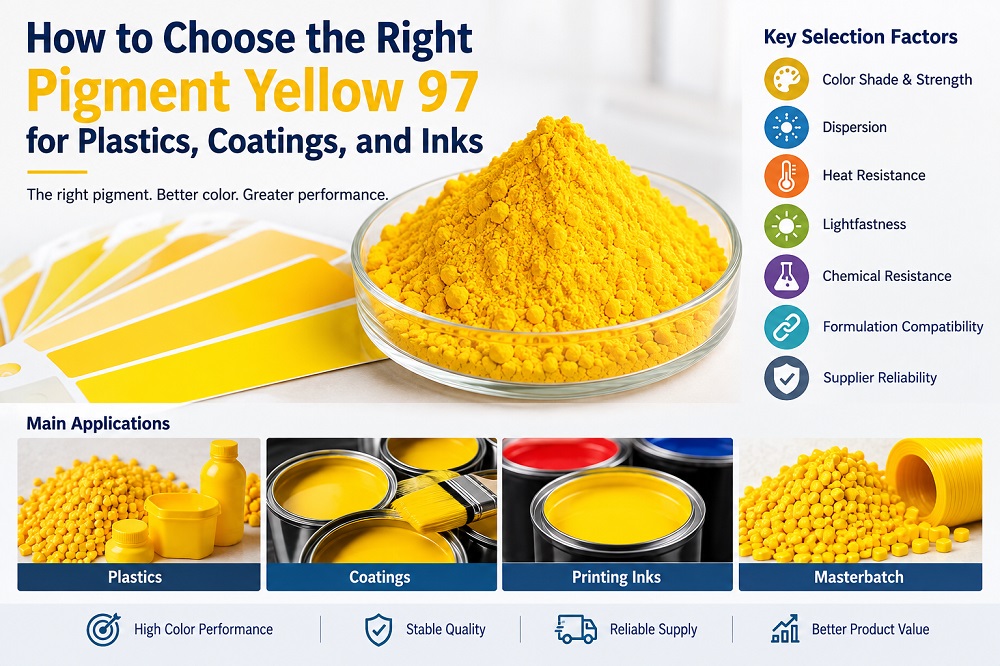
How to Choose the Right Pigment Yellow 97 for Plastics, Coatings, and Inks
Choosing the right ピグメントイエロー 97 is an important decision for manufacturers of plastics, masterbatch, coatings, and printing inks. Although different pigment grades may share the same Color Index designation, their actual performance can vary depending on particle characteristics, manufacturing processes, dispersion properties, formulation compatibility, and application requirements.
For industrial buyers, selecting Pigment Yellow 97 based only on price or color appearance can lead to inconsistent production results. A more effective approach is to evaluate color performance, dispersion, heat resistance, lightfastness, chemical resistance, compatibility, processing conditions, and supply stability before placing a commercial order.
This guide explains the key factors to consider when choosing Pigment Yellow 97 for plastics, coatings, and printing inks and provides practical recommendations for working with a reliable Pigment Yellow 97 manufacturer or supplier.
Why Choosing the Right Pigment Yellow 97 Matters
Pigments play an important role in determining the appearance and performance of colored products. Even when two products are identified as Pigment Yellow 97, differences in manufacturing technology and pigment characteristics can affect their behavior in a specific formulation.
The right grade should provide a suitable balance between color strength, dispersion, processing stability, durability, compatibility, and cost efficiency.
Color Consistency
Industrial manufacturers often need to maintain the same yellow shade across different production batches. A consistent pigment helps reduce color variation and makes production quality easier to control.
Production Efficiency
A pigment with suitable dispersion and coloring strength can simplify processing and help manufacturers achieve the required color at an appropriate concentration.
Finished-Product Performance
The pigment should remain compatible with the final product throughout its expected service life. Factors such as heat, light, chemicals, weathering, and migration may need to be considered depending on the application.
Key Factors When Selecting Pigment Yellow 97
Before purchasing Pigment Yellow 97, manufacturers should establish the technical requirements of the final product. The following factors are particularly important.
Color Shade
The first consideration is the required yellow shade. Color perception can be affected by pigment concentration, particle characteristics, polymer or resin type, dispersion quality, and other formulation components.
Buyers should compare the pigment against an established color standard rather than evaluating the dry pigment alone.
Color Strength
Color strength determines how efficiently the pigment develops color in the selected formulation. Higher coloring efficiency may allow manufacturers to achieve the target shade with a lower pigment concentration.
When comparing different Pigment Yellow 97 suppliers, customers should evaluate color strength using comparable testing conditions.
Dispersion
Dispersion is one of the most important properties for industrial pigment applications. Poor dispersion can result in uneven color, agglomeration, surface defects, and reduced color strength.
The required dispersion characteristics depend on the formulation, processing equipment, carrier system, and application method.
耐熱性
Heat resistance should be carefully evaluated when Pigment Yellow 97 is used in plastics or masterbatch. Processing methods such as extrusion and injection molding may expose the pigment to elevated temperatures.
Buyers should compare the pigment's thermal performance with the actual processing temperature and residence time of their polymer system.
耐光性
Lightfastness becomes particularly important when colored products are exposed to sunlight or artificial light for extended periods.
For outdoor plastics, coatings, and other light-exposed products, manufacturers should request relevant durability data and conduct application testing where necessary.
Chemical Resistance
The surrounding formulation can influence pigment stability. Solvents, acids, alkalis, plasticizers, additives, and other chemicals may affect the performance of a pigment.
For demanding applications, chemical resistance should be evaluated using the actual formulation or representative test conditions.
Choosing Pigment Yellow 97 for Plastics
Plastic applications require pigments that can withstand the relevant processing conditions while providing consistent color and good dispersion. Pigment Yellow 97 can be evaluated for different thermoplastic systems, but the appropriate grade should always be selected according to the polymer and processing requirements.
Consider the Polymer Type
Different polymers have different processing temperatures, chemical characteristics, and additive systems. A Pigment Yellow 97 grade suitable for one polymer may not provide identical performance in another.
Before selecting a pigment, identify the polymer type and review its processing conditions with the pigment supplier.
Check Processing Temperature
Plastic processing can involve high temperatures and significant shear. The pigment should maintain suitable color performance under the actual production conditions.
Laboratory or pilot-scale testing can help determine whether the selected Pigment Yellow 97 grade performs consistently during processing.
Evaluate Dispersion in Masterbatch
When Pigment Yellow 97 is used to produce color masterbatch, dispersion within the carrier resin is critical. Good dispersion helps the masterbatch deliver consistent color when it is diluted into the final polymer.
Compatibility between the pigment and carrier resin should therefore be evaluated before commercial production.
Consider Migration Requirements
For some plastic products, migration behavior can be an important consideration. Manufacturers should evaluate the requirements of the finished product and destination market before selecting a pigment grade.
Choosing Pigment Yellow 97 for Coatings
Coating formulations can contain resins, solvents, additives, and other components that influence pigment performance. Selecting the right Pigment Yellow 97 requires evaluating its compatibility with the complete coating system.
Evaluate Resin Compatibility
The pigment should disperse effectively in the selected binder or resin system. Compatibility can influence color development, gloss, transparency, and overall coating appearance.
Consider Solvent Compatibility
For solvent-based coating systems, the interaction between the pigment and solvent environment should be evaluated. Manufacturers should conduct formulation testing to confirm stability and dispersion.
Evaluate Weathering Requirements
Outdoor coatings may experience sunlight, moisture, temperature changes, and other environmental conditions. The required level of durability should therefore be established before choosing a pigment grade.
Check Gloss and Transparency
Different coating applications may require different levels of opacity, transparency, and gloss. These properties should be evaluated together with pigment concentration and formulation design.
Choosing Pigment Yellow 97 for Printing Inks
Printing ink manufacturers need to consider pigment dispersion, color strength, transparency, viscosity, printing process, and substrate compatibility when selecting Pigment Yellow 97.
Printing Process
Different printing technologies have different formulation and performance requirements. The selected pigment should be compatible with the intended ink system and production process.
Ink Dispersion
Good dispersion helps produce uniform color and can contribute to consistent printing performance. Pigment agglomeration may negatively affect appearance and processing.
Substrate Requirements
The substrate can influence the appearance and final performance of printed color. Paper, plastic films, packaging materials, and other substrates may require different ink characteristics.
Color Strength and Transparency
Ink manufacturers should determine the required balance between color strength, transparency, opacity, and shade before selecting a Pigment Yellow 97 grade.
How to Compare Different Pigment Yellow 97 Suppliers
Once the technical requirements have been established, manufacturers can compare potential Pigment Yellow 97 suppliers using both technical and commercial criteria.
Compare Technical Specifications
Request technical data for color strength, shade, dispersion, heat resistance, lightfastness, chemical resistance, moisture, and other relevant parameters.
Technical specifications should be compared using the same testing standards whenever possible.
Request Samples
A sample is one of the most effective ways to evaluate a Pigment Yellow 97 product. Testing the sample in the customer's actual formulation provides more useful information than relying only on a technical specification sheet.
Evaluate Batch Consistency
For long-term industrial production, consistency between batches is critical. Buyers should ask suppliers how they control color shade, strength, particle characteristics, and other quality parameters during production.
Check Production Capacity
Large-volume buyers should consider whether the supplier has sufficient production capacity to support regular orders and future increases in demand.
Review Documentation
International customers may require technical data sheets, safety documentation, compliance information, product specifications, and other documents. Confirm documentation requirements before placing an order.
Pigment Yellow 97 Cost and Purchasing Considerations
Price is an important factor when purchasing pigments, but it should not be the only selection criterion. The lowest price does not necessarily provide the lowest overall production cost.
Evaluate Cost per Finished Product
Manufacturers should consider pigment loading and coloring efficiency when comparing prices. A pigment with better coloring strength may require less material to achieve the desired shade.
Consider Processing Efficiency
Good dispersion and stable processing can help reduce production problems and improve manufacturing efficiency. These factors should be considered when calculating the overall value of a pigment.
Consider Long-Term Supply
For continuous production, stable supply can be more valuable than a short-term price advantage. Buyers should evaluate production capacity, lead times, minimum order quantities, and inventory planning.
Questions to Ask a Pigment Yellow 97 Manufacturer
Before selecting a supplier, buyers can prepare a list of technical and commercial questions to ensure that the pigment meets their requirements.
Technical Questions
- What Pigment Yellow 97 grades are available?
- Which grade is recommended for my application?
- What are the typical color strength and shade characteristics?
- What dispersion properties can be expected?
- What are the relevant heat resistance and durability characteristics?
- Is the pigment compatible with my polymer or resin system?
Commercial Questions
- What is the minimum order quantity?
- What packaging options are available?
- What is the standard lead time?
- What is the production capacity?
- Can you provide samples before bulk purchasing?
- Can you provide technical and compliance documentation?
Why Work Directly With a Pigment Yellow 97 Manufacturer?
Direct cooperation with a Pigment Yellow 97 manufacturer can provide advantages for companies with regular or large-volume requirements. Customers may receive more direct technical communication, product recommendations, sample support, and supply planning.
Application Support
An experienced manufacturer can help customers identify a suitable grade based on their polymer, coating, ink, or masterbatch system.
Stable Product Quality
Consistent manufacturing and quality control are important for maintaining stable color and processing performance across different orders.
Bulk Supply
Manufacturers with suitable production capacity can support recurring orders and long-term supply programs for industrial customers.
Common Mistakes When Buying Pigment Yellow 97
Choosing Only by Price
A low purchase price does not necessarily mean lower total production cost. Color strength, pigment loading, dispersion, processing efficiency, and product consistency should also be considered.
Comparing Dry Pigments Only
The appearance of a dry pigment sample does not always predict its performance in a specific formulation. Application testing provides a more reliable comparison.
Ignoring Processing Conditions
A pigment should be evaluated according to the actual temperature, residence time, shear, resin, solvent, and additive environment of the production process.
Skipping Sample Testing
Placing a large order without testing the pigment in the intended formulation can create unnecessary production risks. Sample evaluation is recommended before commercial purchasing.
Frequently Asked Questions About Pigment Yellow 97
How do I choose the right Pigment Yellow 97?
Start with the final application and define the required color, color strength, dispersion, heat resistance, lightfastness, chemical resistance, and compatibility requirements. Then compare technical data and test samples in the actual formulation.
Is Pigment Yellow 97 suitable for plastics?
Suitable Pigment Yellow 97 grades can be used in plastic applications. The selected grade should be evaluated according to the polymer type, processing temperature, dispersion requirements, and final-product specifications.
Can Pigment Yellow 97 be used in masterbatch?
Yes. It can be considered for masterbatch production when the pigment provides appropriate dispersion and compatibility with the selected carrier resin.
What should I consider when using Pigment Yellow 97 in coatings?
Important factors include resin compatibility, dispersion, solvent environment, color requirements, gloss, transparency, lightfastness, and weathering requirements.
What should I consider when using Pigment Yellow 97 in printing inks?
Ink manufacturers should evaluate dispersion, color strength, transparency, viscosity, printing process, substrate compatibility, and the required resistance properties.
Should I request a Pigment Yellow 97 sample before purchasing?
Yes. Sample testing is recommended before bulk purchasing because it allows manufacturers to evaluate the pigment under their actual formulation and processing conditions.
How can I find a reliable Pigment Yellow 97 supplier?
Look for a supplier with consistent product quality, appropriate production capacity, technical support, reliable documentation, stable delivery, and experience serving industrial and international customers.
Looking for a Reliable Pigment Yellow 97 Supplier?
If you are sourcing Pigment Yellow 97 for plastics, masterbatch, coatings, printing inks, or other industrial applications, the right supplier can help you reduce formulation risks and maintain consistent production quality.
We supply Pigment Yellow 97 solutions for industrial customers looking for stable quality, technical support, and reliable bulk supply. Whether you are developing a new formulation, replacing an existing pigment supplier, or preparing for regular production, our team can help evaluate your application requirements and recommend a suitable grade.
Request a Pigment Yellow 97 Sample
Send us your application, polymer or resin type, target color, processing conditions, and expected quantity. We can help you evaluate a suitable Pigment Yellow 97 grade and arrange a sample for testing.
Get Technical Data and a Bulk Quote
For commercial purchasing, you can request product specifications, technical documentation, packaging information, and a competitive quotation based on your required volume.
Contact us today to discuss your Pigment Yellow 97 requirements, request a sample, or get a quotation for bulk orders.
Conclusion
Choosing the right Pigment Yellow 97 requires a combination of technical evaluation and practical application testing. Color shade and strength are important, but dispersion, heat resistance, lightfastness, chemical resistance, formulation compatibility, and processing conditions can be equally important.
For plastics and masterbatch, polymer compatibility and thermal performance should receive particular attention. For coatings and printing inks, resin compatibility, dispersion, solvent environment, substrate, and durability requirements should be evaluated according to the formulation.
For long-term industrial purchasing, manufacturers should also consider supplier reliability, batch consistency, production capacity, technical support, documentation, packaging, and delivery capability. By evaluating both product performance and supplier capabilities, buyers can select a Pigment Yellow 97 grade that provides reliable performance and better overall value.
関連製品
 Pigment Yellow 97: Properties, Applications, and Technical Guide
- Pigment Red 146: Properties, Applications, and Technical Guide
- What Is Pigment Red 146 and Where Is It Used?
- What Is Pigment Red 177? Properties, Applications, and Benefits Explained
- Pigment Red 177 Technical Data: Heat Resistance, Light Fastness, and Chemical Stability
- How to Choose a Reliable Pigment Red 177 Manufacturer in China
- Why Pigment Red 177 Is Ideal for Plastic Coloration and Masterbatch Manufacturing
- Pigment Red 177 vs Pigment Red 170: Which Organic Red Pigment Should You Choose?
- Pigment Red 177 for Industrial Coatings: Why It Is the Preferred High-Performance Red Pigment
- Top Applications of Pigment Red 177 in Automotive Coatings, Inks, and Plastics